When people hear experiential learning, they often imagine trust falls, obstacle courses, or a day outdoors with the team.
It’s understandable. For years, experiential learning has been associated with offsites and team-building activities. But that’s only a small part of what it really is.
At its core, experiential learning is about designing experiences that help people think, reflect, and apply new behaviours in the workplace.
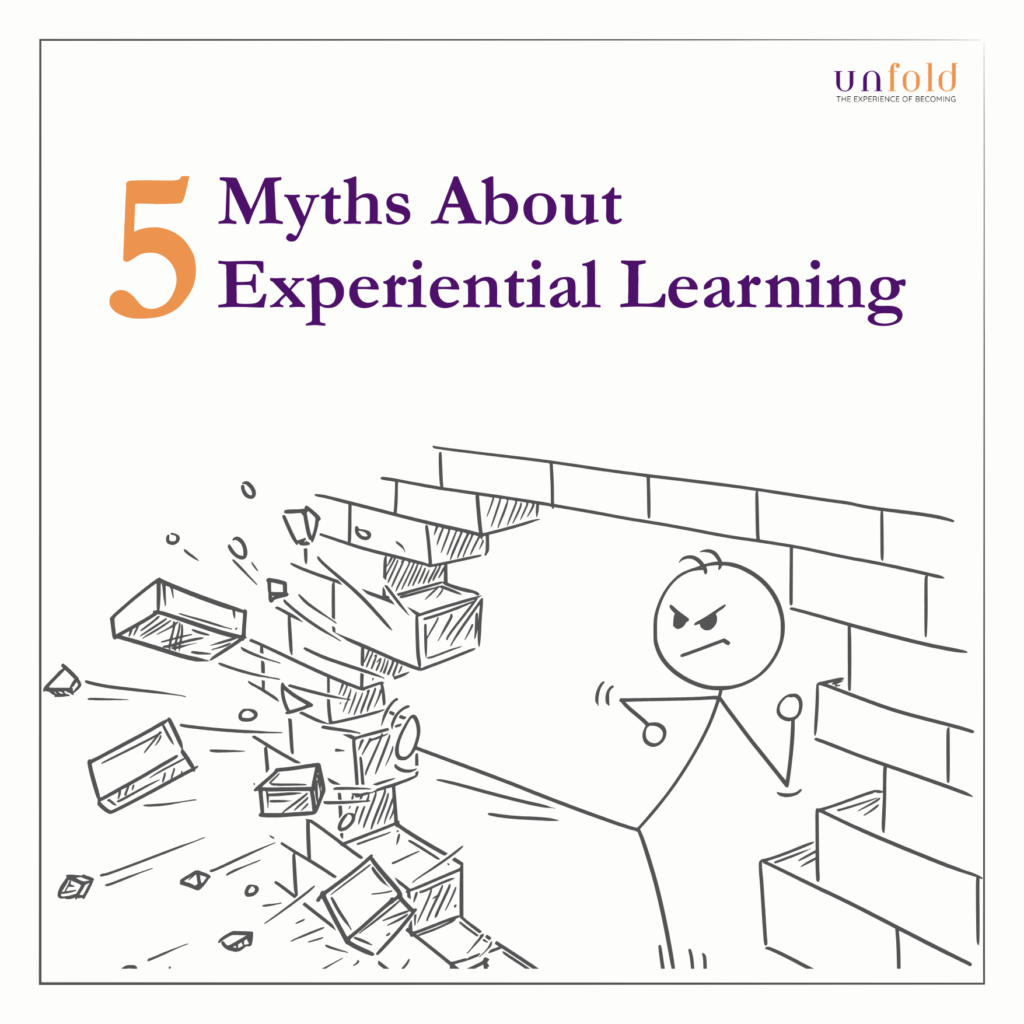
Let’s bust five of the most common myths.
Myth 1: Experiential learning only happens outdoors.
This is perhaps the biggest misconception.
An experience doesn’t require a campsite, ropes course, or outdoor challenge. It can happen inside a meeting room through a carefully designed simulation, a role play, a business case, a reflection exercise, or even a meaningful conversation.
The location doesn’t make learning experiential. The design does.
When people actively participate, make decisions, reflect on their actions, and connect those insights to their work, learning becomes experiential, whether they’re in a conference room or a forest.
Myth 2: It’s only for team-building.
Team-building is one application, not the definition.
Experiential learning can be used to develop leadership, communication, feedback conversations, customer service, problem-solving, sales capability, onboarding, and countless other workplace skills.
Any capability that requires people to think, behave, or respond differently can benefit from experiential learning.
Because behavioural skills aren’t developed by hearing about them. They’re developed by practicing them.
Myth 3: It’s all about fun activities.
Activities are simply the starting point. The learning happens afterwards.
A simulation without reflection is just an exercise, or a game without discussion is simply entertainment.
The facilitator’s role is to help participants unpack what happened, identify patterns, connect the experience to real workplace situations, ask questions that invoke thinking, and decide what they’ll do differently.
That’s where the real learning begins.
Myth 4: The facilitator is the centre of learning.
In traditional training, the facilitator often becomes the primary source of knowledge. The facilitator is telling about the frameworks, ideas and applications.
Experiential learning flips that idea.
The learner becomes the centre. The facilitator designs the experience, creates psychological safety, asks thoughtful questions, and guides reflection, but doesn’t dominate the conversation.
People remember insights they’ve discovered far longer than insights they’ve simply been told.
Myth 5: Experiential learning means covering less content.
Not at all. Experiential learning changes how people engage with content, not how much content exists.
The goal isn’t to move through more slides. The goal is to help people leave with knowledge they can actually use.
Sometimes that means discussing fewer concepts, but exploring them more deeply, practising them, and making them relevant to real work.
Because learning isn’t measured by how much was presented. It’s measured by what people remember and apply.
________________________________________
So, what actually defines experiential learning?
Experiential learning is defined by what people take away from the experience.
When learning encourages people to participate, reflect, make meaning, and apply their insights, it moves beyond information transfer. It becomes an experience that changes the way they think, act, and grow.
And that’s exactly what meaningful workplace learning should do.
What this means for organizations?
The most effective learning experiences aren’t remembered because they were entertaining. They’re remembered because they changed the way people think, sparked meaningful conversations, and led to different actions back at work.
Experiential learning isn’t about replacing presentations with games or taking teams outdoors. It’s about intentionally designing experiences that help people connect ideas to action.
When done well, learning doesn’t end when the workshop does, it continues every time participants apply what they’ve discovered.
How we approach learning at Unfold?
At Unfold, we design learning experiences that help people think, act, and grow.
Whether we’re working on leadership development, communication, creativity, first-time manager programs, or team effectiveness, we begin with one question:
“What experience will help people discover this for themselves?”
Because we believe lasting learning doesn’t happen when people are told what to do. It happens when they experience something that changes the way they see themselves, others, and their work.
That’s the kind of learning we design.
About Unfold
Unfold is a Learning Experience Design Studio that partners with HR and L&D teams to design experiential learning programs for leaders, managers, and teams. We create experiences that help people think with curiosity, act with confidence, and grow with intention.
📧 Email: team@unfoldway.com
💼 LinkedIn: Follow Unfold on LinkedIn
📷 Instagram: Follow Unfold on Instagram